
albertjohnmack
New member
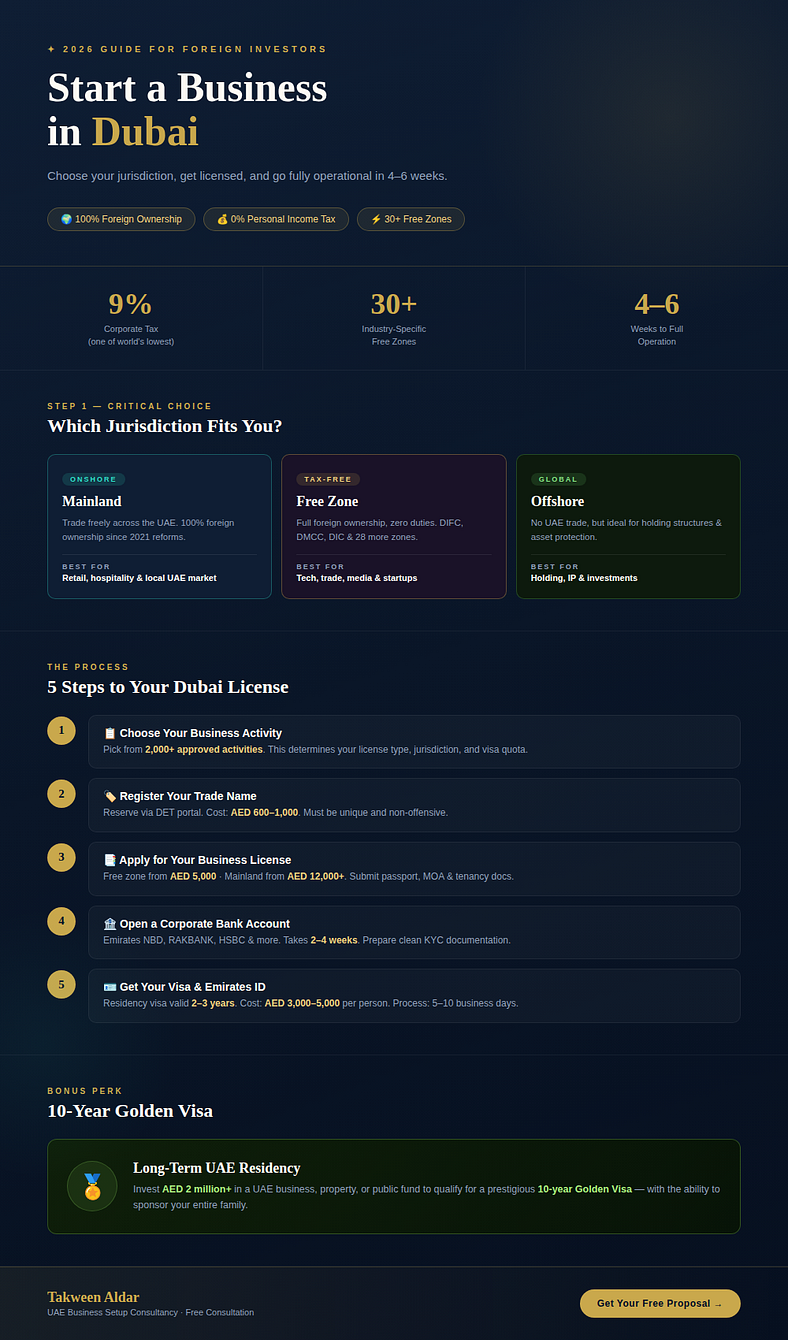
Whether you are a solo founder bootstrapping your first venture or a seasoned investor deploying capital across markets, this guide will walk you through everything you need to know about business setup — from choosing the right jurisdiction and legal structure to obtaining your Emirates ID and corporate bank account. And if you want expert hands-on support at every stage, Takween Advisory is a trusted UAE business consultancy helping foreign investors navigate company formation, PRO services, and government approvals with ease — so you can focus on growth while they handle the groundwork.
Step 1: Choose Your Business Activity

Every business in Dubai must be registered under a specific licensed activity. The Department of Economy and Tourism (DET) maintains a comprehensive list of over 2,000 approved activities spanning commercial, professional, industrial, and tourism sectors.
Your chosen activity will determine:
- Which jurisdiction you can operate in (mainland vs. free zone)
- What type of license you need
- The minimum capital requirements, if any
- The number of visas your company can sponsor
Step 2: Decide Between Mainland, Free Zone, or Offshore

This is perhaps the most critical decision you will make during your business setup Dubai journey. Each jurisdiction offers a distinct set of rules, benefits, and limitations.
Mainland (Onshore)
A mainland company is registered directly with the DET and allows you to trade freely anywhere in the UAE and internationally. Post-2021 reforms now allow 100% foreign ownership for most activity categories — eliminating the old requirement for a 51% Emirati partner.Free Zone
Dubai boasts over 30 free zones, each tailored to a specific industry — from DIFC (finance) and DMCC (commodities) to Dubai Internet City (tech) and Dubai Media City (creative industries). Free zones offer full foreign ownership, zero import/export duties, and simplified setup procedures.Offshore
An offshore company in Dubai (typically registered in Jebel Ali or RAKICC) cannot conduct business within the UAE but is an excellent vehicle for international holding, asset protection, and tax-efficient structures.Step 3: Select Your Legal Structure

Once you have chosen your jurisdiction, you will need to decide on a legal structure. The most common options for foreign investors include:
- LLC (Limited Liability Company): Most popular for mainland setups. Requires a minimum of 2 shareholders.
- Sole Establishment / Sole Proprietorship: Ideal for individual professionals but limited to certain activity types.
- Branch Office: Allows a foreign company to establish a presence in Dubai without creating a new legal entity.
- Free Zone Company (FZC/FZE): Specifically for free zone setups; FZE is a single-shareholder structure, while FZC allows multiple shareholders.
- DIFC or ADGM Entity: For financial services companies regulated under international common law frameworks.
Step 4: Register Your Trade Name
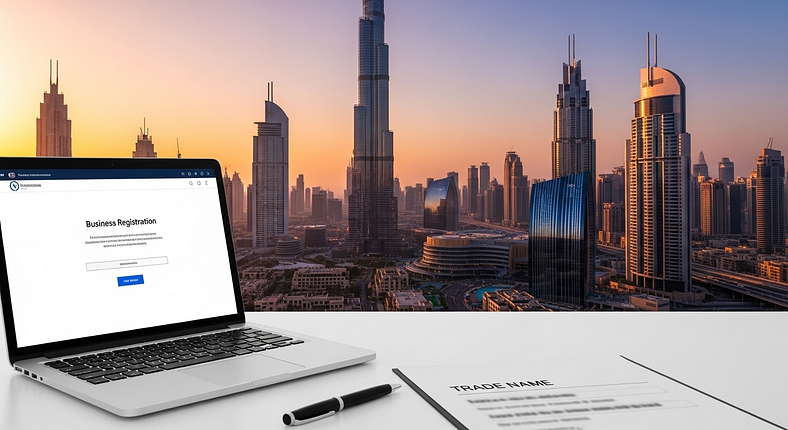
Your company name must comply with UAE naming conventions. The rules are straightforward but important:
- It must not contain offensive or religiously sensitive language.
- It must not replicate an existing registered name.
- It must reflect the nature of your business activity (for some license types).
- Abbreviations of personal names are allowed for professional licenses.
Step 5: Apply for Your Business License

With your trade name approved and legal structure confirmed, you can proceed to the next phase of your business setup in Dubai — license registration. The documents typically required include:
- Passport copies of all shareholders and directors
- Completed application forms (jurisdiction-specific)
- Memorandum of Association (MOA) or Articles of Association
- NOC (No Objection Certificate) from current UAE employer, if applicable
- Business plan (required for some regulated activities)
- Proof of address or tenancy agreement (Ejari for mainland companies)
Step 6: Open a Corporate Bank Account

Dubai’s banking sector is robust and globally connected. Major banks serving foreign business owners include Emirates NBD, Mashreq, RAKBANK, ENBD, and international institutions like HSBC and Citi.
Opening a corporate bank account requires your trade license, MOA, shareholder passports, proof of business activity, and in some cases a business plan. The process typically takes 2–4 weeks and may involve an interview with a bank relationship manager.
Step 7: Apply for Visas and Emirates ID

Once your license is issued, you can begin sponsoring visas. As the business owner, you are entitled to a residency visa, typically valid for 2–3 years and renewable. You can also sponsor visas for employees and dependents based on your company’s visa quota.
The residency visa process involves:
- Entry permit issuance
- Medical fitness test
- Emirates ID registration (biometrics)
- Visa stamping on passport
Ready to Make Your Move? Partner With Takween Advisory Today
Starting a business in Dubai is one of the most rewarding decisions a foreign investor can make — but navigating the paperwork, choosing the right jurisdiction, and staying compliant with UAE regulatory requirements requires local expertise. That is where a professional business setup consultant like Takween Advisory makes all the difference.In case you are planning business setup in UAE, having the right guidance can make the entire process smooth and hassle free. From selecting the right company structure to obtaining approvals and completing legal formalities, every step is important for successful registration. Proper support helps avoid delays and complications. At Takween Advisory, we simplify business setup in UAE with expert assistance and end-to-end consultancy services.
Conclusion
Dubai in 2026 is not just open for business — it is actively engineering the conditions for foreign investors to thrive. With 100% foreign ownership on the mainland, a competitive corporate tax regime, a dynamic free zone ecosystem, streamlined trade license procedures, and long-term residency visa options, the emirate offers one of the most investor-friendly business environments on the planet. From DET approvals to MOA drafting, from Emirates ID registration to VAT compliance — every element of the UAE’s commercial infrastructure is built to support entrepreneurial ambition.You do not have to navigate this journey alone. Takween Advisory brings deep local expertise in UAE company formation, PRO services, government liaison, and investor visa processing — making your transition into the Dubai market smooth, compliant, and cost-effective. The opportunity is real. The infrastructure is ready. The experts are standing by. Now the only question is — are you?
